Plastic pollution has become one of the biggest environmental challenges of modern India. From clogged drains and flooded streets to polluted rivers and dangerous microplastics entering the food chain, the impact of plastic waste is visible everywhere. In West Bengal, particularly in Kolkata and other urban center’s, plastic carry bags have long been identified as a major contributor to environmental degradation.
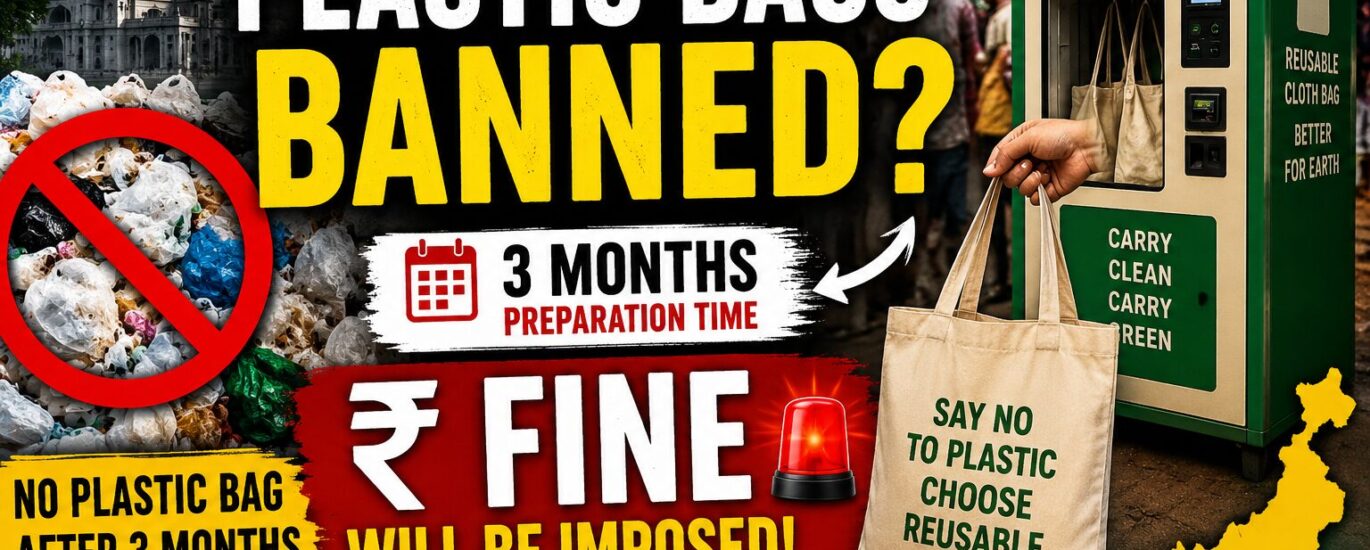
The newly elected West Bengal government has now announced a fresh strategy to tackle this problem. Instead of immediately imposing penalties, the government has decided to first create an alternative system that allows citizens to easily shift away from plastic bags. Under this plan, cloth-bag vending machines will be installed across markets within the next three months. Once these machines are operational, authorities will begin imposing fines on people who continue using banned single-use plastic bags.
This policy represents a combination of enforcement and accessibility. Rather than relying only on punishment, the government is attempting to ensure that consumers have a practical and affordable alternative before stricter action begins.
The Government’s Three-Month Preparation Period
According to Municipal Affairs Minister Agnimitra Paul, cloth-bag vending machines will be installed in markets within three months. After the installation is completed, fines will be imposed on individuals using single-use plastic bags.
The significance of this three-month period cannot be overstated.
Many anti-plastic campaigns fail because citizens are told what they cannot use without being provided with a convenient alternative. The Bengal government appears to be addressing this challenge by ensuring that cloth bags become easily available in market areas before enforcement begins.
The three-month preparation period serves several purposes:
- Installation of vending infrastructure.
- Public awareness campaigns.
- Familiarisation of citizens with the new system.
- Coordination with municipal authorities.
- Reduction of dependence on plastic among shopkeepers.
By the time fines are introduced, authorities will be able to argue that consumers had sufficient access to alternatives and adequate time to adjust their habits.
How the Cloth Bag Vending Machines Will Work
The concept of cloth-bag vending machines is relatively simple.
Just as people purchase water bottles or snacks from vending machines, they will be able to purchase reusable cloth bags from machines installed in market areas.
West Bengal has already experimented with such machines in several locations. Reports from earlier pilot projects indicate that these machines can store hundreds of cloth bags and allow purchases through coins or digital payments. Similar systems have been installed in markets across Salt Lake and other municipal areas.
The objective is straightforward:
A consumer who forgets to bring a reusable bag should not be forced to buy a plastic bag from a vendor. Instead, they can purchase a reusable cloth bag from the machine and continue using it for future shopping trips.
The success of such machines depends on three factors:
- Availability.
- Affordability.
- Ease of use.
If these conditions are met, cloth bags can become a routine part of daily life.
Why Plastic Bags Are Such a Serious Problem
Many people still view plastic bags as harmless because they are lightweight and inexpensive. However, the environmental cost is enormous.
Plastic bags are often used for only a few minutes but remain in the environment for decades.
Unlike organic waste, plastic does not decompose naturally. Instead, it gradually breaks down into smaller fragments known as microplastics.
These microplastics contaminate:
- Soil.
- Rivers.
- Lakes.
- Oceans.
- Groundwater.
- Agricultural land.
Environmental experts warn that microplastics have now been found almost everywhere on Earth, including food, drinking water, and even the air humans breathe.
This means the plastic bag used for carrying vegetables today may continue affecting ecosystems long after its original purpose has ended.
Kolkata’s Drainage Crisis and Plastic Waste
One of the strongest arguments for stricter enforcement comes from Kolkata’s drainage system.
Municipal engineers have repeatedly identified plastic bags as a major cause of clogged drains, blocked manholes, and malfunctioning pumping stations. During heavy rainfall, plastic waste accumulates in drainage infrastructure, preventing the efficient movement of water.
The consequences become particularly severe during the monsoon season.
When drains become blocked:
- Roads remain waterlogged for longer periods.
- Traffic disruptions increase.
- Public health risks rise.
- Municipal maintenance costs increase.
For a city like Kolkata, where heavy rainfall can quickly overwhelm urban infrastructure, reducing plastic waste is not merely an environmental issue—it is also an urban management necessity.
Plastic and Flooding: The Hidden Connection
Many citizens complain about waterlogging during the monsoon without realising how closely it is linked to everyday plastic use.
When plastic bags are discarded irresponsibly, they often end up in:
- Open drains.
- Canals.
- Stormwater channels.
- Water bodies.
Over time, these materials accumulate and form blockages.
The result is simple:
Rainwater that should flow away efficiently remains trapped on roads and residential areas.
Thus, reducing plastic use is not only about protecting nature. It is also about improving urban resilience and reducing flood-related disruptions.
India’s Larger Battle Against Single-Use Plastic
West Bengal’s initiative is part of a broader national effort.
India has taken several steps in recent years to reduce single-use plastic consumption.
The Central Government implemented restrictions on various single-use plastic items and encouraged states to strengthen enforcement mechanisms.
Despite these regulations, implementation has often remained inconsistent.
Several challenges continue to exist:
- Low public awareness.
- Cheap availability of plastic bags.
- Weak enforcement.
- Lack of alternatives.
- Convenience-driven consumer behaviour.
As a result, plastic bags continue to be widely used across many cities and towns despite official bans.
The Bengal government’s approach attempts to address one of the most important barriers: accessibility of alternatives.
Economic Advantages of Cloth Bags
Many people focus only on the environmental benefits of cloth bags, but there are also economic advantages.
A cloth bag can be reused hundreds of times.
A plastic bag is typically used once and discarded.
Over the long term:
- Consumers save money.
- Waste management costs decrease.
- Municipal cleaning expenses reduce.
- Demand for sustainable products increases.
The cloth bag economy can also create employment opportunities.
Manufacturing reusable bags requires:
- Fabric production.
- Stitching.
- Packaging.
- Distribution.
This creates opportunities for small businesses, self-help groups, and local entrepreneurs.
In several parts of India, women’s self-help groups have already become important suppliers of cloth bags.
Health Risks Associated with Plastic Pollution
The health dimension of plastic pollution is often overlooked.
Scientists have increasingly expressed concern about microplastics entering the human body.
Research has detected microplastics in:
- Drinking water.
- Seafood.
- Salt.
- Air.
The World Health Organization has noted that human exposure to microplastic particles is widespread.
Although research is still evolving, concerns include:
- Hormonal disruption.
- Toxic chemical exposure.
- Long-term health impacts.
- Ecosystem contamination.
Reducing plastic consumption therefore benefits not only the environment but potentially public health as well.
Why Enforcement Matters
Awareness alone rarely changes behaviour.
Many cities have conducted anti-plastic campaigns for years without achieving lasting success.
The reason is simple.
If violations carry no consequences, habits remain unchanged.
This is why the Bengal government plans to introduce fines after providing alternatives.
The sequence is important:
First provide options.
Then enforce rules.
This balanced approach is likely to face less public resistance than an immediate crackdown.
Citizens will have access to cloth bags before penalties begin, making enforcement easier to justify.
Challenges the Government May Face
While the plan is promising, implementation will not be easy.
Several challenges remain:
1. Maintenance of Machines
Vending machines must remain functional and stocked.
Empty or broken machines would undermine public confidence.
2. Public Acceptance
People must develop the habit of carrying reusable bags.
Behavioural change takes time.
3. Vendor Compliance
Shopkeepers must stop distributing illegal plastic bags.
4. Consistent Enforcement
Fines must be imposed fairly and consistently.
Selective enforcement could weaken the credibility of the initiative.
5. Supply of Cloth Bags
Authorities must ensure sufficient supply across all markets.
Waste Segregation: Another Important Reform
The government has also signalled a stronger focus on waste segregation.
Citizens are being encouraged to separate wet and dry waste at the household level. Authorities have indicated that households failing to segregate waste may face consequences regarding garbage collection services.
Waste segregation is closely linked to plastic management because mixed waste makes recycling far more difficult.
When plastic is mixed with food waste, its recycling potential decreases significantly.
Therefore, plastic reduction and waste segregation must work together.
Lessons from Other Cities
Across India and around the world, cities have experimented with different methods to reduce plastic use.
Successful strategies generally share common features:
- Easy availability of alternatives.
- Public education campaigns.
- Financial disincentives for plastic use.
- Strong enforcement.
- Community participation.
The cloth-bag vending machine model is increasingly being explored in multiple cities because it combines convenience with environmental responsibility.
A Cultural Shift Is Needed
Ultimately, no government policy can succeed without public participation.
Plastic pollution is not created solely by industries or municipal authorities.
It is the result of millions of daily decisions made by ordinary consumers.
Every time a person accepts a plastic bag for a purchase that could fit into a reusable bag, additional waste enters the system.
Therefore, the real challenge is cultural rather than technological.
Citizens must begin viewing reusable bags as a normal part of daily life.
The same transformation has occurred in many countries where reusable shopping bags are now standard practice.
Conclusion
West Bengal’s decision to install cloth-bag vending machines before imposing fines represents a practical and potentially effective strategy in the fight against plastic pollution. By providing a three-month transition period, the government is attempting to balance environmental responsibility with public convenience. Once the vending machines are operational, enforcement measures will begin, marking a new phase in the state’s efforts to eliminate single-use plastic bags.
The initiative addresses multiple challenges simultaneously: environmental degradation, urban flooding, waste management, public health concerns, and sustainable consumption.
Whether the policy succeeds will depend on implementation, public cooperation, and consistent enforcement. However, the broader message is clear. The era of treating plastic bags as disposable conveniences is coming to an end. Bengal is attempting to replace a culture of single-use consumption with one of reuse and responsibility.
If successfully implemented, this initiative could become a model for other Indian states seeking practical solutions to the growing plastic waste crisis.

 Buy on Amazon