Introduction
Jute bags are one of the most popular eco-friendly alternatives to plastic bags. When dealing with jute bags, terms like 12/12, 13/13, and 14/15 fabric are commonly used. These numbers play a crucial role in determining the quality, texture, strength, and price of the bag.
In this article, we will clearly explain what these numbers mean, their differences, and how they impact your buying decision.
What Does 12/12, 13/13, 14/15 Mean?
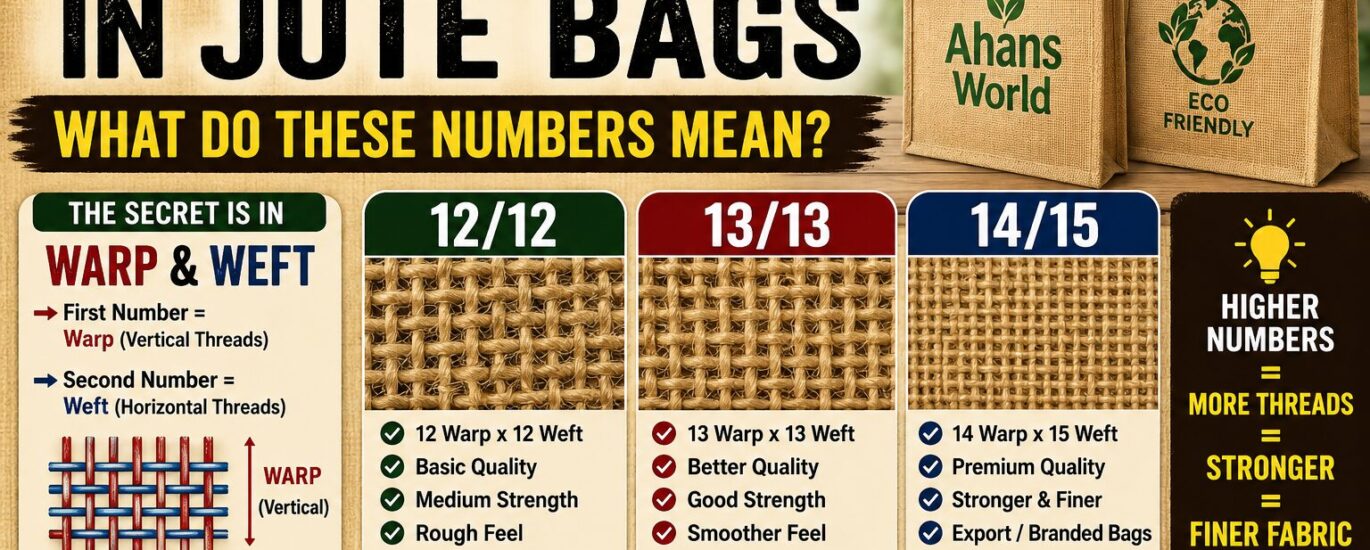
The numbers 12/12, 13/13, and 14/15 refer to the thread density of jute fabric.
- The first number represents the warp (vertical threads)
- The second number represents the weft (horizontal threads)
For example:
- 12/12 means 12 vertical and 12 horizontal threads
- 13/13 means 13 vertical and 13 horizontal threads
- 14/15 means 14 vertical and 15 horizontal threads
Higher numbers indicate more threads woven into the same area, resulting in better fabric quality.
Thread Thickness vs Fabric Quality
This is the most important concept to understand.
High Thread Count (14/15)
To fit more threads in the same space, the threads must be thin and fine. This results in:
- Smooth texture
- Better finishing
- Premium look
Low Thread Count (12/12)
With fewer threads, the yarn is made thicker to fill the gaps, which results in:
- Rough texture
- Less refined appearance
- Basic quality
So, in jute fabric:
- Thin threads with higher density = better quality
- Thick threads with lower density = rough but economical
Difference Between 12/12, 13/13, 14/15 Fabric
12/12 Fabric
This is a basic quality fabric made with thick threads. It has a rough texture and is commonly used for low-cost bags.
13/13 Fabric
This is a balanced option with moderate thread thickness and better finishing. It is widely used in retail jute bags.
14/15 Fabric
This is a premium quality fabric made with finer threads. It has a smooth finish and is mostly used for export-quality bags.
Price Difference in Jute Fabric
The price of jute fabric increases with quality:
- 12/12 fabric is the cheapest
- 13/13 fabric is moderately priced
- 14/15 fabric is the most expensive
The higher cost of 14/15 fabric is due to:
- Higher thread density
- Finer yarn
- Better finishing and appearance
Laminated vs Unlaminated Jute Bags
India Market
In India, customers generally prefer laminated jute bags because:
- They are water-resistant
- They last longer in daily use
- They are suitable for carrying groceries
USA and Export Market
In countries like the USA, buyers prefer unlaminated jute bags because:
- They are fully eco-friendly
- Completely biodegradable
- Do not contain plastic coating
This is one of the main reasons why 14/15 fabric is commonly used for export, as it offers a premium look and meets international quality expectations.
Expert Insight from Ahans World
At Ahans World, I, Devendra Singh, personally prefer using 14/15 fabric because it provides a smoother finish, better quality, and a premium appearance.
However, we also manufacture 12/12 and 13/13 fabric bags based on customer demand, as the price of 14/15 fabric is higher and may not fit every budget.
Our goal is to provide the right balance of quality and pricing based on customer needs.
Final Conclusion
When selecting jute bags, always remember:
- Higher thread count means finer threads and better quality
- Lower thread count means thicker threads and a rougher finish but lower cost
Choosing the right fabric depends on your budget, purpose, and target market.

 Buy on Amazon