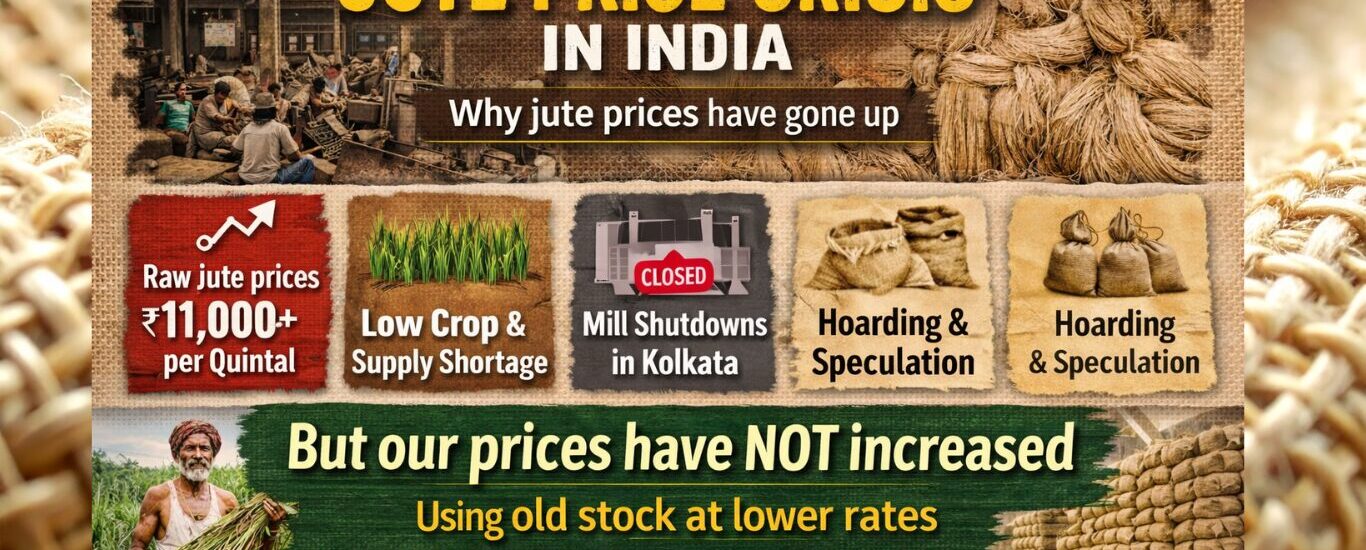
And Why Ahans World Has Not Increased Prices (Yet)
Over the last few months, jute prices in India have increased sharply, creating serious pressure on the entire jute industry — from farmers and traders to mills and manufacturers, especially in West Bengal and the Kolkata jute belt.
At Ahans World, we believe in transparency. Many customers have asked why jute products are becoming costlier in the market and whether prices will rise further. This article explains the real reasons behind the jute price crisis, the current situation, and why we have chosen not to increase prices for now.
1. Sharp Rise in Raw Jute Prices
The biggest reason behind the crisis is the sudden surge in raw jute prices.
- Raw jute prices have crossed ₹10,000–₹11,000 per quintal in many mandis
- This is much higher than historical averages
- Jute mills are buying raw material at record rates, pushing production costs up
For manufacturers, this means higher input costs with no immediate way to pass them on to customers.
2. Reduced Jute Production by Farmers
Another major factor is lower jute cultivation in previous seasons.
- Farmers shifted to other crops due to:
- Low returns in earlier years
- Rising labour and input costs
- Uncertainty around government procurement
- As a result, overall jute output fell, creating a supply shortage
When supply drops and demand remains steady, prices naturally rise.
3. Hoarding and Speculation in the Market
The jute trade has also been affected by speculative buying and stock hoarding.
- Large traders and intermediaries held back raw jute expecting further price increases
- This reduced open market availability for mills
- Mills were forced to buy at higher prices just to keep operations running
Industry bodies have openly warned that unregulated trading is worsening the crisis.
4. Pressure on Jute Mills in Kolkata & West Bengal
The Kolkata–Hooghly jute belt has been hit the hardest.
- Many jute mills are:
- Running at reduced capacity
- Cutting production shifts
- Facing severe working-capital stress
- Some mills have even temporarily shut down operations
This affects not only manufacturers, but also thousands of workers and small businesses dependent on the jute ecosystem.
5. Government Procurement & Policy Challenges
Jute demand heavily depends on government orders, especially for food-grain packaging.
- Delays and uncertainty in procurement schedules
- Inconsistent enforcement of mandatory jute packaging rules
- Competition from cheaper plastic alternatives
All these factors have weakened price stability in the jute sector.
Current Scenario: What Lies Ahead?
- Jute prices are expected to remain high in the short term
- Market stability will depend on:
- Next crop output
- Government intervention
- Better regulation of raw jute trading
Manufacturers across India are under pressure to revise product prices upward.
Why Ahans World Has NOT Increased Prices
Despite the industry-wide cost surge, Ahans World has not increased prices for our jute products.
Here’s why:
- We had old stock procured at earlier, lower rates
- We believe in long-term customer trust, not short-term profit
- We want to absorb the impact rather than pass it on immediately
Our goal has always been to offer sustainable, eco-friendly jute products at fair and honest prices.
However, we also want to be transparent:
If high raw jute prices continue for a prolonged period, price adjustments may become unavoidable across the industry.

 Buy on Amazon